Switzerland has a reputation that scares off a lot of travelers before they even book a flight. “It’s too expensive.” “You’ll go broke in a week.” “A coffee costs $10 there.” Some of that is true. Most of it is exaggerated. This guide breaks down exactly what a trip to Switzerland costs in 2026, so you can decide for yourself whether the reputation matches reality — and how to keep your budget under control if it does.
So, Is Switzerland Actually Expensive?
Yes — genuinely. Switzerland consistently ranks among the most expensive countries in the world for travelers, and prices for everyday things like coffee, restaurant meals, and hotels are noticeably higher than in neighboring Germany, France, or Italy. A simple coffee in Zurich can run around CHF 5, and a cheese fondue dinner in a mountain town like Grindelwald can cost close to CHF 28.
But “expensive” doesn’t mean “impossible.” Switzerland is expensive in the same way that a well-run, high-quality country tends to be — wages, infrastructure, and service standards are all high, and prices reflect that. The good news is that costs are also predictable and manageable once you know what to expect, and there are real ways to cut your daily spending by 30–40% without missing out on the experience.
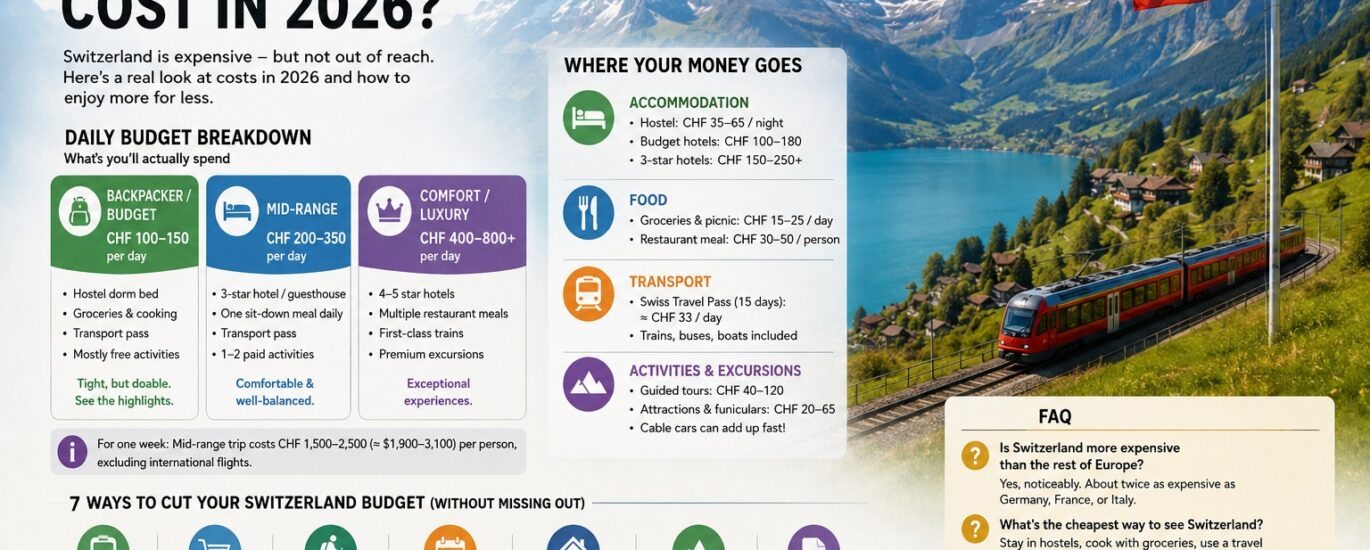
Daily Budget Breakdown: What You’ll Actually Spend
Here’s a realistic, honest look at daily costs by travel style, based on current 2026 pricing.
Backpacker / Budget Travel — roughly CHF 100–150 per day
This covers a dorm bed in a hostel, groceries from budget supermarkets like Coop or Migros, a Half Fare Card or Swiss Travel Pass for transport, and mostly free activities like hiking. It’s tight, but it’s genuinely doable, and you’ll still see the highlights.
Mid-Range Travel — roughly CHF 200–350 per day
This is where most independent travelers land. It typically includes a private room in a 3-star hotel or guesthouse, one proper sit-down meal a day, a transport pass, and one or two paid activities or mountain excursions. It’s comfortable without feeling like you’re overspending.
Comfort / Luxury Travel — CHF 400–800+ per day
Four- and five-star hotels, multiple restaurant meals, first-class trains, and premium mountain excursions like the Bernina Express fall into this range. Switzerland at this level is exceptional, but costs escalate quickly if you’re not tracking them.
For a full week, a mid-range trip typically lands somewhere around CHF 1,500–2,500 (roughly $1,900–3,100) per person, not including international flights.
Where Your Money Actually Goes
Accommodation is usually the single biggest expense. Hostel dorm beds run CHF 35–65 a night, budget hotels and guesthouses are CHF 100–180 for a basic double room, and mid-range 3-star hotels run CHF 150–250 a night. Prices climb further in tourist-heavy alpine towns like Zermatt or Interlaken, where limited supply pushes rates up.
Food is the second-biggest factor, but it’s also the most controllable. Self-catering with Coop or Migros groceries and picnic lunches can bring daily food costs down to CHF 15–25, while a sit-down restaurant dinner typically runs CHF 30–50 per person.
Transport is where Switzerland actually earns its reputation for value. The Swiss Travel Pass gives unlimited access to trains, buses, and boats across the country, and the 15-day version works out to roughly CHF 33 per day — genuinely good value if you’re moving between cities and regions.
Activities and mountain excursions are the wildcard. Guided tours generally cost CHF 40–120 per person, and tickets to major attractions or funicular rides run CHF 20–65. A single cable car ride up a famous peak can meaningfully shift your daily average, so it’s worth budgeting for one or two “splurge” excursions rather than trying to do them all.
7 Ways to Cut Your Switzerland Budget Without Cutting the Experience
- Buy a Swiss Travel Pass in advance. It bundles transport, many museum entries, and discounts on mountain excursions into one predictable cost.
- Shop at Coop or Migros. Groceries here are dramatically cheaper than eating out for every meal, and both chains have solid ready-to-eat options.
- Hike instead of paying for every cable car. Switzerland’s trail network is free, extensive, and arguably the best way to see the Alps anyway.
- Travel in shoulder season. Late spring and early autumn bring lower accommodation prices and thinner crowds than peak summer or ski season.
- Stay in smaller towns instead of city centers. A base outside Zurich, Geneva, or Lucerne often costs noticeably less while still being a short train ride from everything.
- Pick one or two big-ticket excursions, not five. Mountain trips add up fast — choose your favorites (Jungfraujoch, Zermatt, or the Bernina Express, for example) rather than doing them all.
- Get a local SIM or eSIM. Switzerland isn’t part of the EU, so EU roaming plans generally don’t work here, and unexpected roaming charges are an easy way to blow your budget without noticing.
Final Verdict: Expensive, But Worth Planning For
Switzerland is expensive — that part of its reputation is earned. But it isn’t the budget-destroying trap it’s sometimes made out to be. A backpacker can realistically get by on CHF 100–150 a day, a comfortable mid-range trip lands around CHF 200–350 a day, and every price point comes with legitimate ways to save. The key is deciding your travel style upfront and building a realistic budget around it, rather than arriving without a plan and letting costs catch you off guard.
If Switzerland has been on your list, the cost shouldn’t be what keeps you away — a little planning goes a long way here.
FAQ
Is Switzerland more expensive than the rest of Europe? Yes, noticeably. Switzerland typically costs about twice as much as neighboring Germany, France, or Italy for comparable travel.
What’s the cheapest way to see Switzerland? Stay in hostels, cook or picnic with supermarket groceries, use a Swiss Travel Pass or Half Fare Card, and rely on free hiking trails instead of paid excursions.
Is the Swiss Travel Pass worth it? For most multi-city or multi-region trips, yes — it covers trains, buses, and boats, and includes discounts on many attractions and mountain excursions.
How much should I budget for a one-week trip? A mid-range one-week trip generally costs around CHF 1,500–2,500 (about $1,900–3,100) per person, not including flights.