
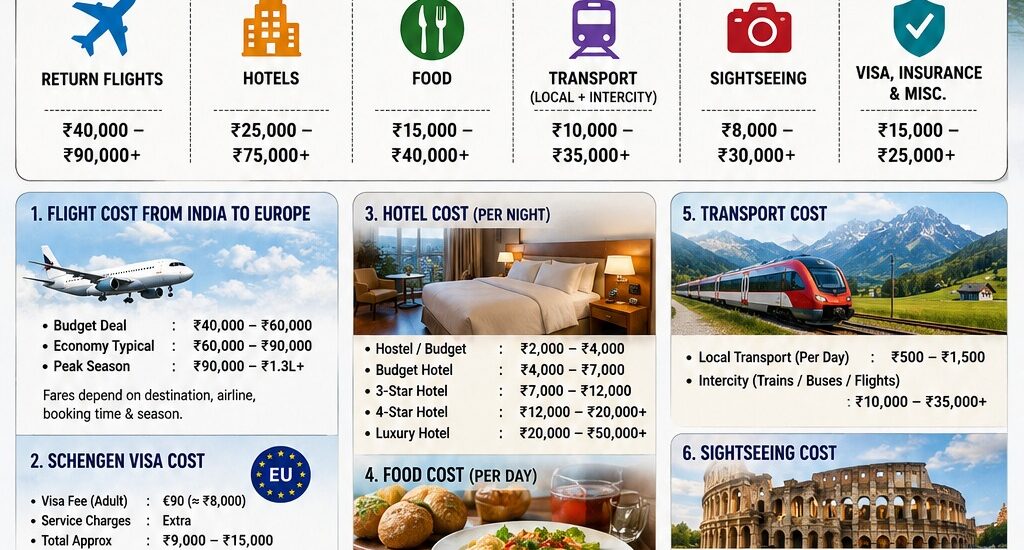
Planning a Europe trip from India in 2026 but not sure how much money you should keep aside? The total cost depends on your destination, travel dates, hotel category, number of countries and the type of experiences you choose.
For a typical 7–10 day Europe holiday, Indian travellers can expect a broad range of around ₹1.5 lakh to ₹3 lakh+ per person, while luxury trips can go considerably higher. Recent 2026 travel estimates place comfortable mid-range trips broadly around the ₹1.5–₹2.5 lakh range, with more expensive routes and longer stays pushing the budget higher.
This guide breaks down the Europe trip cost from India in 2026, including flights, hotels, food, local transport, sightseeing, visa and other important expenses.
Europe Trip Cost From India in 2026 at a Glance
Here is a practical estimate for a 10-day Europe trip per person:
|
Expense |
Budget |
Mid-Range |
Premium |
|
Return Flights |
₹40,000–₹60,000 |
₹60,000–₹90,000 |
₹90,000–₹1.3L+ |
|
Schengen Visa + Service Charges |
₹9,000–₹15,000 |
₹9,000–₹15,000 |
₹9,000–₹15,000 |
|
Hotels |
₹25,000–₹40,000 |
₹45,000–₹75,000 |
₹90,000–₹1.8L+ |
|
Food |
₹15,000–₹25,000 |
₹25,000–₹40,000 |
₹45,000–₹70,000+ |
|
Local & Intercity Transport |
₹10,000–₹20,000 |
₹20,000–₹35,000 |
₹35,000–₹60,000+ |
|
Sightseeing |
₹8,000–₹15,000 |
₹15,000–₹30,000 |
₹30,000–₹60,000+ |
|
Insurance, SIM & Misc. |
₹5,000–₹10,000 |
₹8,000–₹15,000 |
₹15,000–₹25,000 |
|
Approx. Total |
₹1.1L–₹1.85L |
₹1.8L–₹3L |
₹3.1L–₹5.5L+ |
These are planning estimates rather than fixed prices. Airfares, hotel rates and attraction tickets change according to season, availability and destination. Current 2026 estimates from travel-industry sources show similarly wide ranges.
1. Flight Cost From India to Europe
For most travellers, international flights are one of the biggest expenses.
A return economy ticket from major Indian cities such as Delhi, Mumbai, Bengaluru or Hyderabad can vary substantially depending on the destination and booking period.
Approximate return airfare
Budget deal: ₹40,000–₹60,000
Typical economy: ₹60,000–₹90,000
Peak season/premium routes: ₹90,000–₹1.3 lakh or more
Some 2026 travel estimates show that cheaper fares can occasionally bring the international flight portion below ₹50,000, while more typical or peak-period fares can be considerably higher.
How to Save on Flights
Compare multiple departure airports before booking. Keep your dates flexible, check one-stop as well as direct options, and avoid booking at the last minute during major holidays.
Travelling in shoulder or off-peak periods can also reduce the overall trip cost.
2. Hotel Cost in Europe
Accommodation can make a huge difference to your Europe travel budget.
The same number of nights can cost dramatically different amounts in Paris, Zurich or Amsterdam compared with cities in Central or Eastern Europe.
Average hotel budget per night
Hostel/budget accommodation: ₹2,000–₹4,000
Budget hotel: ₹4,000–₹7,000
3-star/mid-range hotel: ₹7,000–₹12,000
4-star hotel: ₹12,000–₹20,000+
Luxury hotel: ₹20,000–₹50,000+
For a 10-night trip, accommodation alone can therefore range from approximately ₹25,000 to ₹2 lakh or more, depending on the destination and hotel category. Current 2026 estimates show a similar spread.
Cheapest Ways to Reduce Hotel Costs
Stay near a metro or railway station instead of paying a premium for the most central address. Couples can also save considerably by sharing a room, while families may reduce the per-person cost by choosing family rooms or apartments.
3. Food Cost in Europe
Food expenses depend heavily on where and how you eat.
A budget traveller can use supermarkets, bakeries, local cafés and inexpensive takeaway restaurants. A traveller eating at sit-down restaurants for lunch and dinner every day will spend considerably more.
Approximate daily food budget
Budget: ₹1,500–₹2,500 per day
Mid-range: ₹2,500–₹4,000 per day
Premium: ₹4,500–₹7,000+ per day
For 10 days, that means approximately:
Budget: ₹15,000–₹25,000
Mid-range: ₹25,000–₹40,000
Premium: ₹45,000–₹70,000+
Indian travellers can also find Indian restaurants in most major European cities, although they may be more expensive than local food options.
4. Transportation Cost in Europe
Europe has an extensive network of trains, metros, buses and budget airlines.
Your transport budget depends on how many cities you visit.
For example, visiting Paris and Amsterdam is much simpler than trying to cover Paris, Amsterdam, Switzerland, Italy, Germany and Austria in the same trip.
Approximate transport budget for 10 days
Budget: ₹10,000–₹20,000
Mid-range: ₹20,000–₹35,000
Premium: ₹35,000–₹60,000+
For city travel, public transport is usually the best way to control spending.
For intercity travel, compare point-to-point train tickets, advance fares, buses and rail passes before purchasing a pass.
5. Sightseeing Cost in Europe
Sightseeing expenses can range from almost nothing for outdoor attractions to hundreds of euros if you visit several major paid attractions.
Popular experiences can include:
- Eiffel Tower
- Louvre Museum
- Colosseum
- Vatican Museums
- Swiss mountain excursions
- Amsterdam museums
- River cruises
- Palace and castle tours
- Guided day trips
Approximate sightseeing budget
Budget traveller: ₹8,000–₹15,000
Mid-range traveller: ₹15,000–₹30,000
Premium traveller: ₹30,000–₹60,000+
A good strategy is to identify your must-see attractions before your trip instead of buying every available tour or ticket.
6. Schengen Visa Cost for Indian Travellers
Indian citizens generally require a Schengen visa for short tourist trips to the Schengen Area.
The European Commission currently lists the standard adult Schengen visa fee at €90, with an additional service fee possible when applications are submitted through an external visa service provider.
A short-stay Schengen visa normally allows stays of up to 90 days within a 180-day period, subject to the visa conditions.
When planning your budget, keep around ₹9,000–₹15,000 aside for visa-related costs, depending on the exchange rate and applicable service charges.
7. Travel Insurance
Travel insurance is an important part of a Europe trip and is also among the standard supporting requirements for a Schengen visa application.
A basic travel insurance policy may cost relatively little compared with the overall trip, but prices depend on age, coverage, trip duration and policy features.
For budgeting purposes, keeping around ₹600–₹1,500+ per person for basic coverage is a reasonable planning figure, although you should compare actual policies before purchasing.
8. How Much Does a 7-Day Europe Trip Cost From India?
A short Europe holiday can be completed at different budget levels.
Budget 7-Day Trip
Approximate cost:
₹1.2 lakh–₹1.7 lakh per person
This generally means economical flights, hostels or budget hotels, public transport, affordable food and carefully selected attractions.
Mid-Range 7-Day Trip
Approximate cost:
₹1.7 lakh–₹2.5 lakh per person
This allows better hotels, more comfortable transport and a larger sightseeing budget.
Premium 7-Day Trip
Approximate cost:
₹2.5 lakh–₹4 lakh+ per person
This can include better hotels, premium rail journeys, more expensive destinations, private transfers and premium experiences.
A 2026 travel estimate suggests that a carefully planned seven-day trip can fit around the ₹2 lakh mark when flights, accommodation, transport and activities are booked strategically.
9. How Much Does a 10-Day Europe Trip Cost From India?
For a first-time traveller, 10 days is a popular trip length.
A practical planning range is:
Budget: ₹1.3 lakh–₹1.8 lakh
Mid-range: ₹1.8 lakh–₹3 lakh
Premium: ₹3 lakh–₹5 lakh+
The destination mix matters enormously. A route focused on Central Europe can be substantially cheaper than one dominated by Switzerland, Paris and other high-cost destinations.
10. How Much Does a 14-Day Europe Trip Cost From India?
For travellers planning a two-week holiday, the total cost generally increases because of additional hotel nights, food, transport and activities.
A current 2026 estimate puts a 14-day Europe trip around ₹1.5 lakh–₹3 lakh+ per person, depending on travel style, although individual budgets can be lower or much higher.
For a comfortable two-week trip through destinations such as Paris, Amsterdam, Switzerland and Rome, planning around ₹2.25 lakh–₹3.5 lakh per person is a sensible starting point before premium upgrades and shopping.
11. Which European Countries Are Cheapest?
Not every part of Europe costs the same.
For travellers trying to control their budget, destinations in Central and Eastern Europe can often provide better value than places such as Switzerland or some major Western European capitals.
Countries and destinations frequently considered for budget-friendly European travel include:
Hungary
Czechia
Poland
Portugal
Parts of the Balkans
More expensive destinations often include:
Switzerland
Iceland
Norway
Paris and other major Western European capitals
One 2026 comparison estimated daily travel costs at roughly ₹3,000–₹5,000 in Prague, ₹8,000–₹12,000 in Paris and ₹12,000–₹18,000 in Zurich at the budget level, illustrating how dramatically destination choice can change the final bill.
12. Example Europe Budget From India
Suppose you are planning a 10-day route covering Paris, Amsterdam, Switzerland and Italy.
A reasonable mid-range budget could look like this:
Flights: ₹70,000
Visa + insurance: ₹12,000
Hotels: ₹55,000
Food: ₹30,000
Intercity + local transport: ₹25,000
Sightseeing: ₹20,000
SIM + miscellaneous: ₹8,000
Estimated Total: ₹2,20,000 per person
This is an example budget, not a fixed package price. Switzerland, peak-season travel, centrally located hotels or premium experiences can push the total substantially higher.
13. How to Reduce Your Europe Trip Cost
The biggest savings usually come from planning rather than cutting everything from your holiday.
Book flights and popular hotels early, travel during shoulder seasons, use public transport, choose a logical route and avoid changing hotels every night.
Food is another major saving opportunity. Having breakfast from a bakery or supermarket, eating one main restaurant meal each day and using local cafés can reduce your daily expenses.
Also remember that adding another country is not automatically better. Every additional destination means another transport ticket, another hotel check-in and more travel time.
14. Best Budget for a First Europe Trip From India
For most travellers, a useful target is:
₹1.5 Lakh
Possible for a carefully planned budget trip, particularly with cheaper destinations and off-season travel.
₹2 Lakh
A realistic target for a well-planned budget-to-mid-range trip.
₹2.5–₹3 Lakh
A comfortable budget for many 7–10 day itineraries.
₹3 Lakh+
Better suited to longer trips, Switzerland-heavy routes, premium hotels, shopping or more expensive experiences.
Europe Travel in 2026: Important Border Update
The Entry/Exit System (EES) became fully operational across the Schengen external borders on 10 April 2026. It records relevant entry and exit information, including biometric data, for applicable non-EU short-stay travellers.
The European Commission also says ETIAS is scheduled to begin in the last quarter of 2026. Indian citizens travelling to the Schengen Area for short stays still require a visa and therefore do not need ETIAS.
Final Verdict: How Much Money Do You Need for Europe in 2026?
For an Indian traveller planning a 7–10 day Europe trip in 2026, keeping around ₹1.5 lakh–₹3 lakh per person is a practical starting point.
A strict budget traveller may spend less, while Switzerland, peak-season travel, luxury accommodation, extensive shopping or private tours can push the cost above ₹3 lakh.
The smartest way to plan your budget is to calculate the trip in this order:
Flights + Visa + Hotels + Food + Transport + Sightseeing + Insurance + Emergency Buffer
Once these numbers are estimated, you can decide whether a budget, mid-range or luxury Europe holiday fits your travel plans.