Planning your first Europe trip from India can be exciting, but travelling across multiple European countries requires some preparation. From understanding the Euro and choosing the right SIM card to using trains, finding Indian-friendly food and managing your daily expenses, a little planning can make your trip much easier.
Europe has excellent public transportation, diverse cuisines, historic cities, beautiful landscapes and a wide range of accommodation options. However, costs, local rules and payment methods can vary from one country to another.
This complete Europe travel guide for Indians covers everything you should know before and during your European holiday.
Europe Trip From India: Quick Overview
|
Travel Requirement |
Important Information |
|
Visa |
Schengen Visa for most Schengen countries |
|
Main Currency |
Euro (€), but not used everywhere |
|
SIM |
European eSIM or local SIM |
|
Transport |
Trains, metro, buses and flights |
|
Payment |
Cards + some cash |
|
Language |
English is widely understood in tourist areas |
|
Travel Insurance |
Strongly recommended and generally required for Schengen visa |
|
Best Travel Period |
April–June & September–October |
|
Typical Daily Budget |
€70–€150+ per person |
|
Documents |
Passport, visa, insurance, bookings & tickets |
1. Currency in Europe
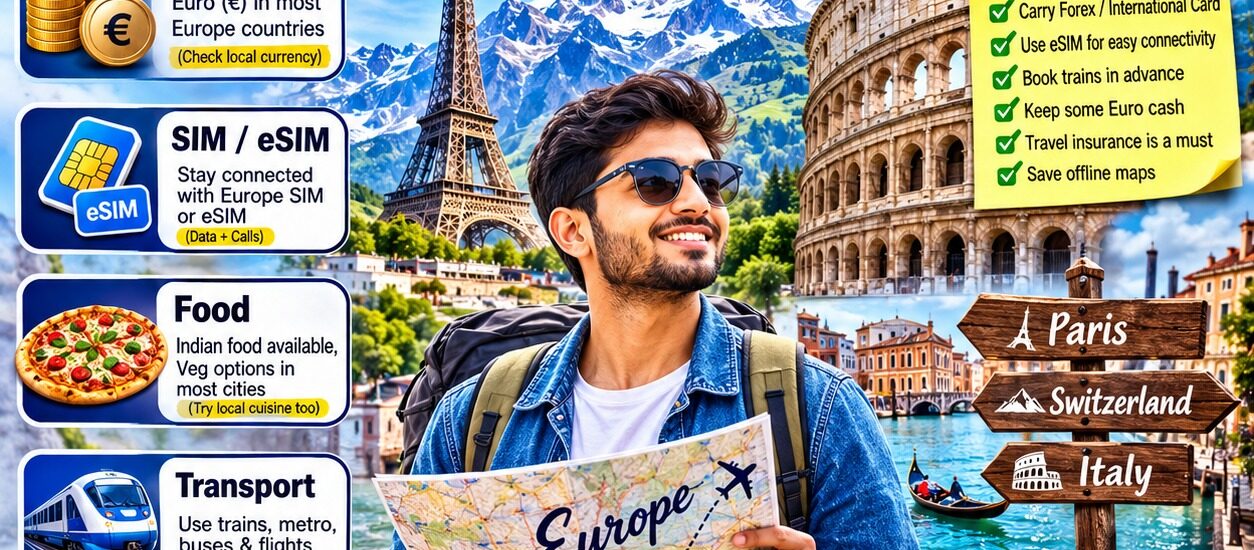
The Euro (€) is the main currency used across many European countries.
Countries such as France, Italy, Germany, Spain, Austria, Portugal and Greece use the Euro.
However, remember that Europe is not one single currency zone.
For example:
- Switzerland uses Swiss Franc (CHF)
- United Kingdom uses Pound Sterling (GBP)
- Denmark uses Danish Krone (DKK)
- Sweden uses Swedish Krona (SEK)
- Norway uses Norwegian Krone (NOK)
- Poland uses Polish Złoty (PLN)
- Hungary uses Hungarian Forint (HUF)
Therefore, check the currency of every country included in your itinerary.
Should Indians Carry Euros?
Yes. Carrying a small amount of euros in cash is useful, but you don’t need to carry your entire travel budget in cash.
A good approach is:
International card + backup card + small amount of cash
Cards are accepted widely in major European cities, particularly at hotels, restaurants, supermarkets and transport ticket machines.
Should You Exchange Indian Rupees in Europe?
Usually, it is better to arrange some euros before departure or withdraw money through a suitable international card/ATM rather than exchanging large amounts of INR at airports.
Airport exchange counters can have less favourable rates.
Before travelling, check:
- Foreign transaction fees
- ATM withdrawal charges
- Currency conversion rates
- Daily withdrawal limits
- International usage settings
2. SIM Card and eSIM for Europe
Staying connected is extremely important when travelling through Europe.
You will need mobile data for:
- Google Maps
- Train information
- Hotel directions
- Translation
- Online tickets
- Ride-hailing apps
- Restaurant searches
- Emergency communication
eSIM vs Physical SIM
eSIM
An eSIM is convenient because you can purchase and activate it before leaving India.
Advantages include:
- No physical SIM replacement
- Easy activation
- Multiple country coverage
- Useful immediately after landing
- Your Indian SIM can potentially remain active for calls/OTP depending on your setup
Physical SIM
A physical European SIM can also work well, especially if you need a local phone number.
Before purchasing, check whether the plan covers all the countries on your itinerary.
How Much Data Do You Need?
For normal travel:
5–10 GB: Light users
10–20 GB: Regular travellers
20 GB+: Heavy users, video calls and frequent hotspot use
If you mainly use maps, WhatsApp and browsing, you generally don’t need an unlimited plan.
3. Food in Europe for Indian Travellers
Food is one of the biggest concerns for many Indian travellers.
The good news is that major European cities have plenty of Indian restaurants, vegetarian restaurants and international food options.
You can commonly find Indian restaurants in:
- Paris
- London
- Amsterdam
- Zurich
- Milan
- Rome
- Berlin
- Vienna
- Barcelona
However, Indian restaurants may be more expensive than eating local food.
Vegetarian Food
Vegetarian travellers can usually find:
- Pizza
- Pasta
- Salads
- Sandwiches
- Bakery products
- Vegetarian curries
- Rice dishes
- Vegetarian Asian food
When ordering, clearly mention:
“I am vegetarian. No meat, chicken or fish.”
If you have strict dietary requirements, check the ingredients carefully.
Indian Food Budget
A restaurant meal in major European cities can easily cost more than a similar meal in India.
For budget travellers, supermarkets and bakeries can be useful.
You can buy:
- Bread
- Fruits
- Yogurt
- Cheese
- Sandwiches
- Salads
- Ready-to-eat meals
- Snacks
- Bottled drinks
This can significantly reduce your daily food budget.
4. Drinking Water in Europe
Tap water is generally safe to drink in many European countries, although local conditions can vary.
Carrying a reusable bottle can save money because buying bottled water repeatedly can become expensive.
Some cities also have public drinking-water fountains.
Always check local guidance if you’re unsure.
5. Transportation in Europe
One of the biggest advantages of travelling around Europe is the extensive transportation network.
You can use:
- High-speed trains
- Regional trains
- Metro
- Trams
- Buses
- Ferries
- Domestic flights
For many city-to-city journeys, trains are one of the most convenient options.
European Train Travel
Popular high-speed train networks include:
- France’s TGV
- Italy’s Frecciarossa
- Spain’s AVE
- Germany’s ICE
- Switzerland’s extensive rail network
For example:
Paris → Switzerland → Italy
can be comfortably covered by train.
Should You Buy a Eurail Pass?
A Eurail Pass can be useful if you’re visiting multiple countries and taking several train journeys.
However, don’t automatically assume it will be cheaper.
Compare:
Individual train tickets vs Eurail Pass
before purchasing.
If your itinerary contains only a few long-distance journeys, individual tickets booked early can sometimes offer better value.
6. Public Transport in European Cities
Most major European cities have excellent public transportation.
You may find:
- Metro
- Bus
- Tram
- Regional trains
- Local commuter trains
Before travelling, download the relevant transport apps and save your hotel location offline.
Google Maps is also extremely useful for checking routes and estimated journey times.
Important Tip
Always validate or activate tickets when required.
In some European cities, travelling without a correctly validated ticket can result in a significant fine.
7. Taxi and Ride-Hailing Apps
Taxis are available across Europe, but prices can be high.
Use official taxi stands or reputable ride-hailing applications where available.
Before getting into a taxi, check:
- Estimated fare
- Pickup location
- Vehicle details
- Payment method
Avoid unofficial drivers approaching tourists at airports or major tourist attractions.
8. Accommodation Tips for Indians
Hotels in major European cities can be expensive.
When selecting accommodation, don’t look only at the hotel price.
Check:
- Distance from metro/train station
- Reviews
- Check-in time
- Room size
- Breakfast
- Cancellation policy
- Luggage storage
- Tourist tax
- Air conditioning
- Elevator availability
A hotel slightly outside the city centre but close to public transport can offer better value.
Hotel vs Hostel vs Apartment
Hotel
Best for families, couples and travellers who want convenience.
Hostel
Good for solo travellers and budget travellers.
Apartment
Useful for families or groups, particularly when cooking facilities are available.
9. Schengen Visa for Indian Travellers
If you are travelling to countries within the Schengen Area, Indian passport holders generally need a Schengen visa for tourism.
Common documents include:
- Valid passport
- Visa application
- Photographs
- Flight itinerary
- Hotel bookings
- Travel itinerary
- Travel insurance
- Bank statements
- Proof of income
- Employment/business documents
- Supporting financial documents
One important point is to apply through the appropriate Schengen country according to the applicable main-destination rules.
Don’t create a fake itinerary simply to obtain a visa.
10. Travel Insurance
Travel insurance is extremely important for a European trip and is generally required for Schengen visa applications.
A suitable policy can help cover eligible expenses related to:
- Medical emergencies
- Hospitalisation
- Trip cancellation
- Baggage problems
- Travel delays
- Emergency assistance
Read the policy terms carefully rather than choosing a policy only because it is cheap.
11. How Much Money Should You Budget Per Day?
Your daily budget depends on your travel style.
Budget Traveller
Approximately €50–€80 per day
Possible with:
- Hostel/cheap accommodation
- Supermarket meals
- Public transportation
- Limited paid attractions
Mid-Range Traveller
Approximately €80–€150 per day
Usually includes:
- Comfortable hotel
- Restaurant meals
- Public transport
- Several attractions
Premium Traveller
€150+ per day
May include:
- 4–5 star hotels
- Premium restaurants
- Private transfers
- More paid experiences
- First-class travel
These are broad planning estimates, not fixed prices.
12. Tipping Culture in Europe
Tipping practices vary from country to country.
Unlike the United States, tipping is generally not expected at the same level everywhere in Europe.
In some countries, service charges may already be included.
Before tipping, check the bill and local customs.
A small tip for good service can be appropriate depending on the country and situation.
13. Important European Travel Apps
Before leaving India, install useful travel applications.
Google Maps
Useful for:
- Walking directions
- Public transport
- Restaurants
- Attractions
Google Translate
Useful when you encounter languages you don’t understand.
Airline App
Keep your flight information accessible.
Train Operator Apps
Useful for:
- Train schedules
- Tickets
- Platform information
- Delays
Hotel Booking App
Keep your accommodation confirmations accessible offline.
14. Internet and Offline Maps
Don’t depend entirely on mobile internet.
Before travelling:
- Download offline Google Maps
- Save hotel addresses
- Screenshot important tickets
- Save emergency contacts
- Download boarding passes
- Keep copies of important documents
This can be extremely useful if your mobile data stops working.
15. Power Adapter for Europe
Indian plugs may not work directly with every European socket.
Carry a universal travel adapter.
If you’re carrying:
- Phone
- Laptop
- Camera
- Smartwatch
- Power bank
- Tablet
a multi-port charger can reduce the number of adapters you need.
16. European Travel Safety Tips
Europe is generally a popular destination for tourists, but pickpocketing can occur in crowded tourist areas.
Be particularly careful around:
- Metro stations
- Train stations
- Major tourist attractions
- Crowded markets
- Public transport
- Busy shopping streets
Keep your passport and valuables secure.
Avoid keeping your wallet or phone in an easily accessible back pocket.
Passport Safety
Carry a photocopy or digital copy of your passport and visa separately.
Keep the original passport secure unless you need it for travel or identification.
17. Avoid Tourist Scams
Common tourist scams can include:
- Fake petitions
- Distraction techniques
- Unofficial taxi drivers
- Overpriced services
- Fake charity requests
- Pickpocketing groups
If someone approaches you unexpectedly, remain cautious.
Don’t hand your phone, wallet or passport to strangers.
18. What Clothes Should Indians Pack?
Your clothing depends heavily on the season.
For summer:
- T-shirts
- Comfortable trousers
- Light jacket
- Comfortable walking shoes
- Sunglasses
- Sunscreen
For winter:
- Thermal layers
- Warm jacket
- Sweater
- Gloves
- Cap
- Warm socks
- Waterproof footwear
If Switzerland is included in your itinerary, pack according to the mountain weather rather than only the city temperature.
19. How Much Luggage Should You Carry?
Avoid overpacking.
A practical setup for a multi-city Europe trip is:
1 check-in suitcase + 1 cabin bag + 1 small personal bag
Remember that you’ll frequently move between hotels and train stations.
Light luggage makes European train travel much easier.
20. Important Documents to Carry
Create a digital and physical backup of important documents.
Keep copies of:
- Passport
- Schengen visa
- Flight tickets
- Hotel bookings
- Travel insurance
- Train tickets
- Attraction tickets
- Driving licence, if applicable
- Emergency contacts
Store important documents securely online as well as offline.
21. Best Time to Visit Europe From India
April to June
Excellent for sightseeing, outdoor activities and pleasant weather.
July to August
Peak summer season.
Expect:
- More tourists
- Higher hotel prices
- Busy attractions
September to October
One of the best periods for many European destinations.
You can often enjoy comfortable weather with fewer crowds than peak summer.
November to March
Good for:
- Christmas markets
- Winter experiences
- Skiing
- Snow destinations
But weather can be cold and daylight hours shorter.
22. Common Mistakes Indian Travellers Should Avoid
Mistake 1: Visiting Too Many Countries
Trying to visit 8–10 countries in 10 days can make the trip exhausting.
Mistake 2: Not Checking Visa Rules
Always verify current visa requirements before booking non-refundable travel.
Mistake 3: Carrying Only Cash
Cards are widely accepted, so don’t carry your entire budget as physical cash.
Mistake 4: Ignoring Local Transport
Airport taxis can be expensive. Check public transportation first.
Mistake 5: Booking Everything at the Last Minute
Flights, hotels and popular attractions can become expensive during peak periods.
Mistake 6: Overpacking
You may have to carry your luggage through railway stations and between hotels.
Mistake 7: Not Checking Train Stations
Large European cities may have multiple stations. Always check the exact station shown on your ticket.
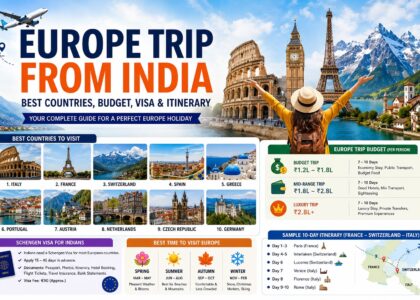
23. Sample 12-Day Europe Itinerary From India
A popular first-time itinerary could look like this:
Day 1: India → Paris
Day 2: Paris sightseeing
Day 3: Paris sightseeing
Day 4: Paris → Switzerland
Day 5: Lucerne
Day 6: Interlaken
Day 7: Swiss Alps
Day 8: Switzerland → Milan
Day 9: Milan → Venice
Day 10: Venice → Florence
Day 11: Florence → Rome
Day 12: Rome sightseeing → India
For a more relaxed holiday, increase the trip to 14–16 days.
24. Europe Travel Budget From India
For a 12–15 day trip, a broad estimate might be:
|
Expense |
Approximate Budget |
|
Return flights |
₹50,000–₹90,000 |
|
Schengen visa & service charges |
₹10,000–₹12,000 |
|
Travel insurance |
₹1,500–₹4,000 |
|
Accommodation |
₹50,000–₹1,00,000+ |
|
Intercity transport |
₹20,000–₹45,000 |
|
Food |
₹25,000–₹50,000 |
|
Local transport |
₹8,000–₹15,000 |
|
Attractions |
₹15,000–₹35,000 |
|
SIM/eSIM & miscellaneous |
₹3,000–₹10,000 |
|
Approx. Total |
₹1.8–₹3.6 lakh+ |
Your actual cost can be significantly higher or lower depending on the countries, season, hotels and activities you choose.
Europe Travel Checklist for Indians
Before leaving India, make sure you have:
- Valid passport
- Schengen visa, where required
- Travel insurance
- Flight tickets
- Hotel bookings
- Train/transport tickets
- International payment card
- Some local currency
- SIM/eSIM
- Universal adapter
- Medicines and essentials
- Offline maps
- Digital document backups
- Emergency contacts
Final Tips for Indians Travelling to Europe
Europe becomes much easier when you plan the basics before departure.
Book major transportation and accommodation early, use trains where practical, keep a combination of cards and cash, download offline maps, carry comfortable shoes and don’t try to cover too many destinations in one trip.
Most importantly, remember that Europe is not one country. Currency, transport systems, languages, food, tipping customs and local rules can change between countries.
A little research before every destination can save both money and time.
Conclusion
A trip to Europe from India can be an incredible experience when planned properly. Understanding currency, SIM cards, food, transportation, accommodation, visa requirements, travel insurance and safety will help you travel more confidently.
Whether you’re planning a romantic Paris trip, a Switzerland adventure, an Italy holiday or a multi-country European tour, create a realistic itinerary, keep an emergency budget and leave enough time to actually enjoy each destination.
With smart planning, public transportation and advance bookings, travelling around Europe can be comfortable, memorable and much more affordable than many first-time travellers expect.