
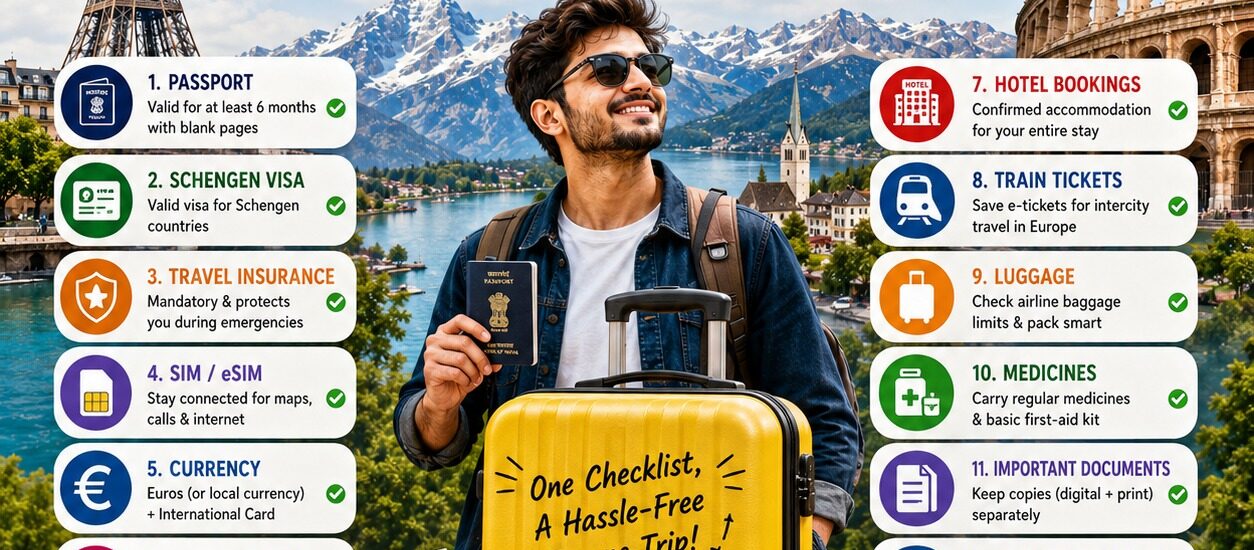
Planning a trip to Europe from India? A proper Europe travel checklist can save you from last-minute stress, missed documents and unnecessary expenses. Whether you’re travelling to Paris, Switzerland, Italy, Germany, Spain, Greece or multiple European countries, preparing your passport, visa, travel insurance, SIM, currency, luggage and flight documents in advance is essential.
This complete Europe travel checklist for Indians covers everything you should prepare before leaving India, what to keep in your hand luggage and what to check after reaching Europe.
Europe Travel Checklist at a Glance
|
Essential Item |
What You Need |
|
Passport |
Valid passport with sufficient validity |
|
Schengen Visa |
Required for eligible Indian travellers visiting Schengen countries |
|
Flight Tickets |
Confirmed onward/return itinerary |
|
Travel Insurance |
Appropriate international travel coverage |
|
Hotel Bookings |
Confirmed accommodation |
|
SIM/eSIM |
Europe-compatible mobile data |
|
Currency |
Euros + international payment card |
|
Boarding Pass |
Digital and/or printed copy |
|
Train Tickets |
For intercity European travel |
|
Luggage |
Check airline weight and size limits |
|
Medicines |
Personal medicines and prescriptions |
|
Travel Documents |
Digital + physical backups |
1. Passport
Your passport is the most important document for international travel.
Before your Europe trip, check:
- Passport validity
- Blank pages
- Passport condition
- Name spelling
- Date of birth
- Passport number
- Expiry date
Make sure all information matches your flight and visa documents.
Keep Passport Copies
Keep:
- One photocopy
- One secure digital copy
- One copy accessible separately from your original passport
Never keep all your important documents and your passport in the same bag.
2. Schengen Visa
If your itinerary includes Schengen countries, Indian citizens generally need an appropriate Schengen visa for tourism.
Before travelling, check:
- Visa validity dates
- Number of permitted entries
- Duration of stay
- Passport number printed on the visa
- Conditions mentioned on the visa
If your itinerary covers multiple Schengen countries, make sure your application follows the applicable main-destination rules.
Important Tip
Don’t rely only on screenshots of your visa.
Carry your original passport containing the visa and keep a digital backup of your visa documents.
3. Flight Tickets & Boarding Pass
Before leaving India, verify your flight details carefully.
Check:
- Departure airport
- Terminal
- Flight number
- Departure time
- Baggage allowance
- Connecting airport
- Arrival airport
- Return flight
Download your airline’s mobile application and keep your booking reference available.
Boarding Pass
You can generally use a digital boarding pass where accepted, but having a backup copy of important travel documents is always sensible.
4. Travel Insurance
Travel insurance is an important part of your Europe travel preparation and is generally required for Schengen visa applications.
Before buying a policy, check whether it provides appropriate coverage for:
- Emergency medical treatment
- Hospitalisation
- Emergency assistance
- Trip cancellation/interruption where applicable
- Baggage-related problems
- Travel delays
Don’t choose a policy only because it has the lowest price.
Read the exclusions and coverage limits carefully.
5. Hotel & Accommodation Bookings
Keep confirmation details for every hotel or accommodation.
Your booking information should clearly show:
- Hotel name
- Address
- Check-in date
- Check-out date
- Booking reference
- Guest name
If you’re visiting several European cities, organize your bookings chronologically.
For example:
Paris → Zurich → Lucerne → Milan → Venice → Florence → Rome
This makes immigration questions and hotel check-ins much easier to handle.
6. SIM Card or eSIM
A reliable internet connection is extremely useful in Europe.
You’ll need mobile data for:
- Google Maps
- Train schedules
- Boarding passes
- Hotel directions
- Translation
- Ride-hailing
- Restaurant searches
- Emergency communication
eSIM
An eSIM can be activated before or after arrival, depending on the provider and your device.
Advantages include:
- No physical SIM swapping
- Easy activation
- Multi-country plans
- Convenient for short trips
Physical SIM
You can also purchase a local SIM if you prefer a physical card.
Before buying a plan, check whether it covers all countries on your itinerary.
7. Currency & Payment Cards
The Euro (€) is used in many European countries, but not every European country uses the Euro.
For example:
- Switzerland → Swiss Franc
- United Kingdom → Pound Sterling
- Norway → Norwegian Krone
- Sweden → Swedish Krona
- Denmark → Danish Krone
- Poland → Polish Złoty
Therefore, don’t assume that euros will work everywhere in Europe.
Best Payment Strategy
Carry:
International debit/credit card + backup card + some cash
Cards are widely accepted in many European cities, but having some cash can be useful for small purchases and situations where cards aren’t accepted.
Before departure, check your bank’s:
- International transaction fees
- ATM withdrawal charges
- Foreign exchange markup
- Daily limits
- International usage settings
8. Luggage
Before packing, check your airline’s baggage allowance.
Pay attention to:
- Check-in baggage weight
- Cabin baggage dimensions
- Personal-item allowance
- Restricted items
- Liquid restrictions
- Power-bank rules
For a multi-city Europe trip, avoid carrying unnecessarily heavy luggage.
You may have to move your suitcase through:
- Railway stations
- Metro stations
- Airports
- Hotels
- Streets
- Train platforms
A lighter suitcase can make the entire trip easier.
9. Clothes
Pack according to the season and destinations.
Spring/Summer
Consider:
- T-shirts
- Light trousers
- Comfortable shoes
- Light jacket
- Sunglasses
- Hat/cap
- Sunscreen
Autumn/Winter
Consider:
- Thermal layers
- Sweater
- Warm jacket
- Gloves
- Warm socks
- Cap
- Waterproof footwear
If Switzerland or other mountain destinations are included, check mountain weather separately.
10. Comfortable Shoes
Don’t underestimate how much you’ll walk in Europe.
You may walk several kilometres every day while exploring:
- Historic city centres
- Museums
- Markets
- Railway stations
- Tourist attractions
- Old towns
Take at least one pair of comfortable walking shoes.
For rainy destinations, waterproof footwear can also be useful.
11. Universal Travel Adapter
Indian plugs may not fit directly into every European socket.
Carry a universal travel adapter.
If you’re travelling with multiple devices, consider a compact multi-port charger.
Typical devices include:
- Smartphone
- Laptop
- Camera
- Smartwatch
- Tablet
- Power bank
12. Power Bank
A power bank can be extremely useful during long sightseeing days.
You may need your phone continuously for:
- Navigation
- Tickets
- Maps
- Translation
- Photos
- Communication
However, always check your airline’s current rules regarding power banks and carry them according to those requirements, generally in cabin baggage rather than checked luggage.
13. Medicines
If you take regular medicines, carry enough for your trip and keep them properly packed.
Consider carrying:
- Personal prescription medicines
- Basic first-aid supplies
- Prescription/doctor documentation where appropriate
- Necessary health-related documents
Keep essential medicines in your cabin baggage rather than putting everything in checked luggage.
For prescription or controlled medicines, check the destination country’s rules before departure.
14. Travel Documents Folder
Create one physical travel folder containing your important documents.
Include copies of:
- Passport
- Visa
- Travel insurance
- Flight bookings
- Hotel bookings
- Train tickets
- Attraction tickets
- Emergency contacts
Also maintain a secure digital backup.
15. Offline Maps
Don’t depend entirely on mobile internet.
Before leaving India:
- Download offline maps
- Save your hotels
- Save airports
- Save major train stations
- Save important attractions
This is especially helpful if your SIM or eSIM has connectivity problems.
16. Train Tickets
If you’re travelling between European cities by train, keep your tickets accessible.
For every journey, check:
- Departure city
- Arrival city
- Station name
- Train number
- Departure time
- Seat number
- Platform information when available
Large cities sometimes have multiple railway stations, so always check the exact station printed on your ticket.
17. Attraction Tickets
Popular attractions can become busy, particularly during peak tourist seasons.
Depending on the attraction, consider booking in advance for places such as:
- Eiffel Tower
- Louvre Museum
- Colosseum
- Vatican Museums
- Major Swiss mountain excursions
- Popular museums
- Guided tours
Save digital tickets on your phone and keep your booking references accessible.
18. Emergency Contacts
Before travelling, save important numbers and contact details.
Keep:
- Indian Embassy/Consulate information
- Hotel contact
- Travel insurance emergency number
- Airline contact
- Bank helpline
- Family emergency contact
It’s also a good idea to keep these details somewhere offline.
19. Banking Preparation
Before leaving India, inform your bank if required and make sure your cards are enabled for international transactions.
Check:
- International usage
- Contactless payments
- ATM withdrawals
- Foreign transaction fees
- Daily limits
Carry a second card separately as a backup.
If your primary card is lost or blocked, the backup card can be extremely valuable.
20. Food Preparation for Indian Travellers
If you have specific food preferences, research restaurants before travelling.
Major European cities often have:
- Indian restaurants
- Vegetarian restaurants
- Vegan restaurants
- Halal restaurants
- Supermarkets
- International food options
You can also carry permitted packaged snacks from India, but always check the destination country’s customs and food-import rules before packing food items.
21. Important Apps
Install useful apps before leaving India.
Google Maps
For navigation and public transport.
Google Translate
For communicating in languages you don’t understand.
Airline App
For flight updates and boarding information.
Train Apps
For schedules, tickets and delays.
Hotel Booking App
For reservations and accommodation details.
Banking Apps
For checking transactions and managing your cards.
22. Safety Checklist
Europe is a popular tourist destination, but tourists can still encounter pickpocketing and scams.
Be especially careful in:
- Crowded metros
- Train stations
- Tourist attractions
- Busy shopping streets
- Large public events
Avoid keeping your phone and wallet in easily accessible back pockets.
Use a secure bag and stay aware of your surroundings.
23. Before Leaving India: Final Checklist
Use this checklist one day before your flight.
- Passport checked
- Schengen visa checked
- Flight tickets confirmed
- Boarding pass downloaded
- Hotel bookings saved
- Travel insurance saved
- Train tickets downloaded
- SIM/eSIM arranged
- International card activated
- Backup card packed
- Euros/cash arranged
- Universal adapter packed
- Power bank packed according to airline rules
- Medicines packed
- Comfortable shoes packed
- Weather-appropriate clothes packed
- Offline maps downloaded
- Important documents backed up
- Emergency contacts saved
24. What to Keep in Your Cabin Bag
Your cabin bag should contain the items you cannot afford to lose.
Keep:
- Passport
- Visa
- Wallet
- International cards
- Phone
- Charging cable
- Power bank
- Essential medicines
- Important documents
- Travel insurance
- Basic toiletries
- One change of clothes
Don’t put your passport, visa or essential medicines inside your checked luggage.
25. What to Keep in Your Checked Bag
Your checked suitcase can contain:
- Main clothes
- Shoes
- Jackets
- Toiletries permitted in checked baggage
- Extra accessories
- Non-essential personal items
Always follow your airline’s current restrictions for liquids, batteries and other restricted items.
26. Europe Travel Checklist for Couples & Families
If you’re travelling as a couple or family, create a shared folder containing:
- Flight bookings
- Hotel confirmations
- Insurance
- Visa copies
- Train tickets
- Emergency contacts
However, each traveller should also keep access to their own passport and essential personal documents.
For children, carry the documents required for your specific family situation and destination.
27. One-Week Before Europe Trip Checklist
One week before departure:
- Confirm flights
- Confirm hotels
- Check visa details
- Check weather
- Check currency
- Activate international banking
- Purchase SIM/eSIM
- Download travel apps
- Download offline maps
- Book important attractions
- Confirm train tickets
- Check luggage allowance
- Prepare medicines
- Organize documents
28. One-Day Before Departure Checklist
The day before your flight:
Passport? ✔
Visa? ✔
Flight ticket? ✔
Insurance? ✔
Hotel bookings? ✔
Money/cards? ✔
SIM/eSIM? ✔
Luggage? ✔
Power bank? ✔
Documents? ✔
Boarding pass? ✔
If everything is checked, you’re ready to travel.
Conclusion
A successful Europe trip from India starts before you reach the airport. Having your passport, Schengen visa, travel insurance, flight tickets, accommodation bookings, SIM/eSIM, currency, payment cards and luggage properly organized can make your journey significantly smoother.
The most important rule is simple: keep essential documents backed up, carry important items in your cabin bag and check the latest airline, visa and destination requirements before departure.
With this Europe travel checklist for Indians, you can prepare systematically and focus on enjoying your European adventure instead of worrying about last-minute travel problems.
Pack smart, plan ahead and enjoy your Europe trip!