
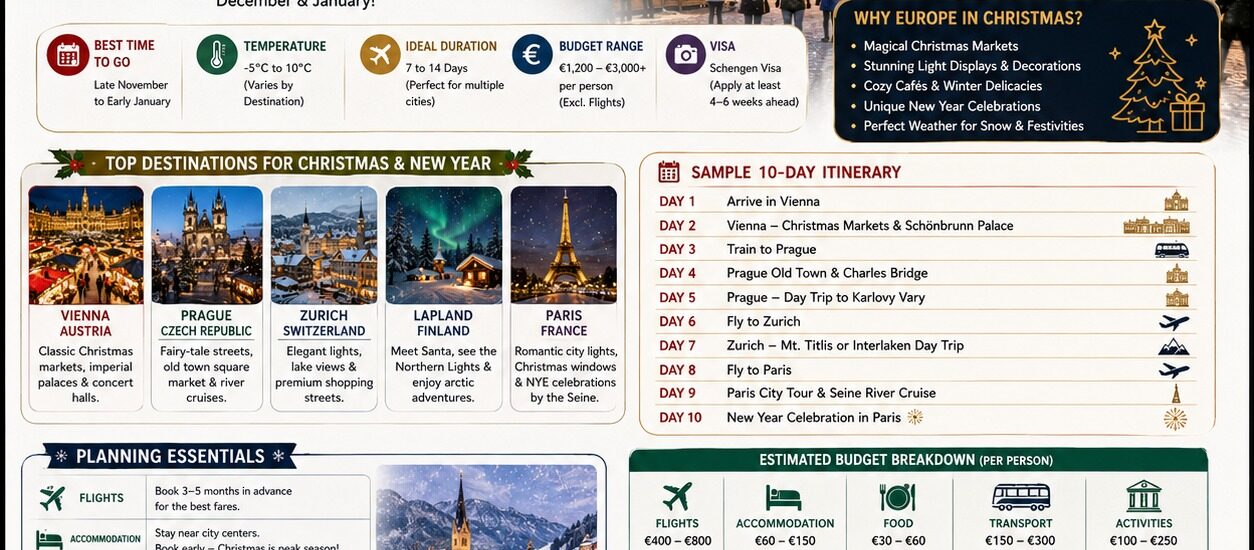
Europe during the festive season is one of the most rewarding — and most bookable-out-in-advance — trips you can plan. Twinkling Christmas markets, mulled wine, ice rinks, and fireworks over centuries-old squares make it worth the cold. But with hundreds of markets and dozens of “best New Year city” lists floating around, narrowing it down takes some real planning. Here’s a full breakdown.
When Do European Christmas Markets Open in 2026?
Most Christmas markets across Europe open in the second half of November and run through Christmas Eve, though several major cities extend their markets into early January to cover the New Year period too. Vienna’s flagship market at Rathausplatz, for example, typically runs from mid-November through late December, with the ice rink often staying open past that into January. Cologne’s market traditionally runs from mid-November through the first week of January, making it one of the longer-running options if you’re combining Christmas and New Year in one trip.
Practical takeaway: If your trip spans both Christmas and New Year, choose cities with markets that run into January rather than ones that close on Christmas Eve.
Best Cities for a Christmas Market Trip
- Vienna, Austria — Classic Christkindlmarkt atmosphere, horse-drawn carriages, and a giant tree in front of the Rathaus. Multiple markets across the city mean you can spend 2–3 days without repeating one.
- Strasbourg, France — Widely considered the birthplace of the modern Christmas market, with the historic old town lit up in a way few other cities match.
- Prague, Czech Republic — The Old Town Square market is one of the most photographed in Europe, set against medieval architecture, and it’s generally more affordable than Western European alternatives.
- Nuremberg & Dresden, Germany — Two of the oldest and most traditional markets in the world, both strong picks if you want the “original” Christkindlmarkt experience.
- Colmar & Strasbourg, France — Colmar in particular functions almost like an entire town turned into a Christmas market, with several smaller markets within walking distance of each other.
- Budapest, Hungary; Krakow, Poland; Tallinn, Estonia — All three offer a similar festive atmosphere at a noticeably lower cost than Vienna or Zurich, making them strong picks for a budget-conscious trip.
Best Cities for New Year’s Eve
Christmas markets and New Year’s Eve don’t always overlap in the same city, so it’s worth deciding which matters more to your itinerary.
- Edinburgh, Scotland — Hogmanay is one of the most famous New Year’s celebrations in the world, with a multi-day festival built entirely around the turn of the year.
- Vienna, Austria — The city’s New Year’s concerts and fireworks around the Ringstrasse make it a strong double-duty choice if you’re already there for the markets.
- Berlin, Germany — One of the largest open-air New Year’s Eve parties in Europe, centered around the Brandenburg Gate.
- Rome & Florence, Italy — Quieter, more scenic New Year’s options if fireworks-and-crowds isn’t the vibe you want.
Budgeting for a Festive Trip
Festive season travel in Europe is peak season pricing in most cities — flights, hotels, and even train tickets rise noticeably from late November through early January. A few ways to manage this:
- Book accommodation early. Smaller Christmas market towns like Colmar have very limited lodging, and rooms sell out months ahead. Many travelers end up doing these as day trips from a larger base city instead.
- Mix expensive and affordable cities. Pairing a splurge city like Zurich or Vienna with a lower-cost stop like Krakow or Tallinn keeps the average trip cost down without sacrificing atmosphere.
- Watch shoulder dates. Traveling in the first half of December, right after markets open, is generally cheaper and less crowded than the final week before Christmas.
Sample 7-Day Itinerary: Christmas Markets + New Year
- Days 1–2: Vienna — Christmas markets, the Rathausplatz tree, and a day trip to the Schönbrunn Palace market
- Days 3–4: Prague — Old Town Square market, castle views, budget-friendly food and drink
- Days 5–7: Berlin — Christmas markets through the 24th, then staying on for one of Europe’s biggest New Year’s Eve celebrations at the Brandenburg Gate
This route works well by train, keeping travel days short between stops while covering both the classic market experience and a major New Year’s celebration.
Quick Planning Checklist
- Book flights and central accommodation 3–4 months out for major cities
- Confirm exact market dates before booking, since they shift slightly year to year and some close on Christmas Eve itself
- Pack for genuinely cold weather, most of these cities sit well below freezing at night in December
- If mixing multiple cities, check whether a rail pass makes sense for your route (see our Eurail Pass guide for a full cost breakdown)
FAQs
Is Christmas a good time to visit Europe? Yes, if you enjoy markets, festive lighting, and cold-weather atmosphere. It’s peak season for many cities, so prices are higher and it’s worth booking early.
Which European city is best for both Christmas markets and New Year’s Eve? Vienna and Berlin are among the few cities that offer a strong version of both — active Christmas markets through late December and major New Year’s Eve events.
Do all Christmas markets stay open until New Year? No. Many close on or shortly after Christmas Eve. Cities like Cologne and Vienna tend to run longer, into early January, but always check specific dates before booking a New Year trip around one.