
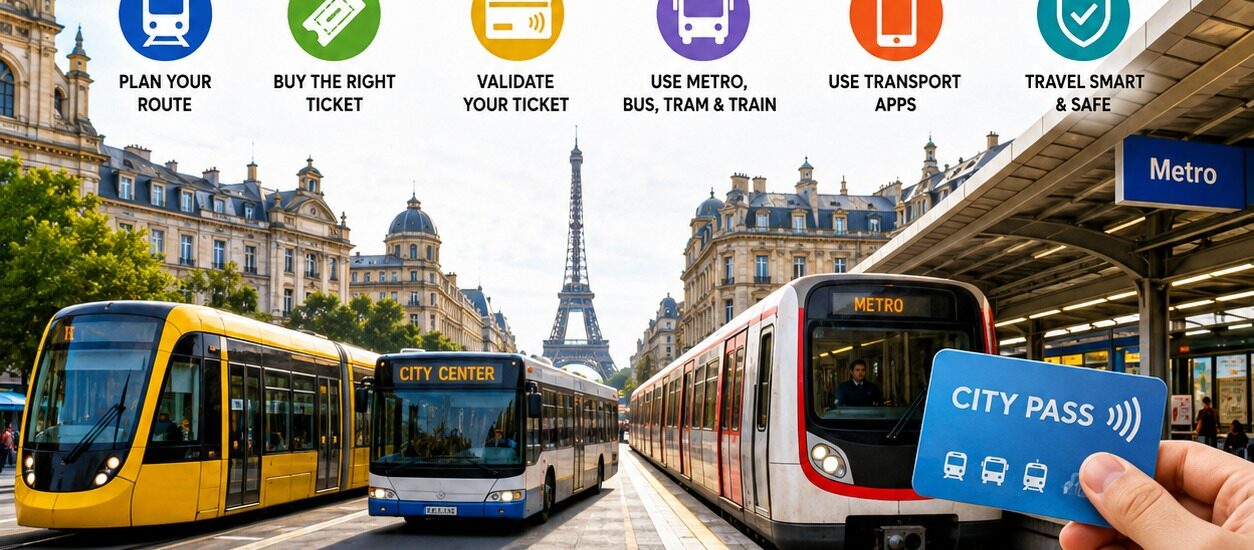
Public transport is one of the easiest, cheapest, and most convenient ways to explore Europe. From high-speed metros in Paris and London to trams in Amsterdam and buses in Rome, European cities have well-connected transportation systems that make sightseeing much easier.
For first-time visitors, however, understanding how to buy tickets, validate passes, use metro systems, and avoid common transport mistakes can be confusing.
This complete 2026 guide to public transport in major European cities explains how transportation works in popular destinations including Paris, London, Rome, Amsterdam, Berlin, Barcelona, Vienna, and Prague.
Whether you’re planning a solo trip, family vacation, honeymoon, or budget Europe tour, this guide will help you travel around European cities confidently.
Why Use Public Transport in Europe?
Public transportation is usually the best option for exploring major European cities.
Main benefits include:
- Lower cost: Usually cheaper than taxis and private transfers.
- Convenience: Metro, buses, trams, and trains connect most tourist areas.
- Less traffic: Public transport can save significant travel time.
- Easy sightseeing: Many attractions have nearby metro or tram stations.
- Environmentally friendly: Public transportation produces fewer emissions per passenger.
- No parking problems: You don’t have to worry about expensive city-center parking.
In many European cities, you can reach major tourist attractions within minutes using public transport.
1. Public Transport in Paris, France
Paris has one of Europe’s largest and most convenient public transport networks.
The system includes:
- Metro
- RER trains
- Buses
- Trams
- Regional trains
The Paris Metro is particularly useful for tourists because many major attractions are located close to metro stations.
Popular attractions accessible by public transport
- Eiffel Tower
- Louvre Museum
- Arc de Triomphe
- Notre-Dame
- Montmartre
- Champs-Élysées
- Versailles
Paris Transport Tips
Download an official transport app before traveling and check your route before leaving your hotel.
If you’re staying in Paris for several days, compare the cost of individual tickets with available travel passes before purchasing one.
Tip: Don’t automatically buy the most expensive tourist pass. Calculate how many journeys you actually expect to make.
2. Public Transport in London, UK
London has one of the world’s most famous public transportation systems.
The main options include:
- London Underground
- Buses
- Overground trains
- Elizabeth line
- DLR
- Trams
- National Rail services
The London Underground, commonly called the “Tube,” is usually the fastest way to travel around central London.
How to Pay
Visitors can generally use:
- Contactless bank cards
- Mobile wallets
- Oyster cards
- Applicable travel passes
Simply tap in when entering the system and tap out when required.
London Travel Tip
London uses a daily and weekly fare-capping system for eligible payment methods, which can make frequent travel more affordable.
Always use the same payment method throughout the day so your journeys can be properly calculated toward the applicable cap.
3. Public Transport in Rome, Italy
Rome has an extensive public transportation network consisting mainly of:
- Metro
- Buses
- Trams
- Regional trains
The Metro is particularly useful for reaching popular attractions.
Major attractions connected by public transport
- Colosseum
- Roman Forum
- Spanish Steps
- Vatican City
- Trevi Fountain
- Termini Station
Rome’s historic center is also highly walkable, so combining walking with public transport is often the best strategy.
Rome Transport Tip
Avoid relying entirely on buses when you’re traveling during busy periods. Traffic can make journeys slower than expected.
For sightseeing, consider taking the Metro to a convenient station and walking the remaining distance.
4. Public Transport in Amsterdam, Netherlands
Amsterdam is famous for its:
- Trams
- Buses
- Metro
- Trains
- Ferries
Trams are especially useful for tourists visiting the central areas.
Amsterdam Transport Tips
Before boarding, check whether you need to check in and check out using your chosen payment method or travel product.
You can also use public transport to reach attractions outside the historic center.
Important Tip
Amsterdam is one of Europe’s most bicycle-friendly cities. However, visitors should be careful when crossing bicycle lanes because bicycles have priority in many situations.
Don’t walk casually into a marked cycle lane.
5. Public Transport in Berlin, Germany
Berlin has an excellent public transport system operated through a combination of:
- U-Bahn
- S-Bahn
- Trams
- Buses
- Regional trains
The U-Bahn is the underground metro, while the S-Bahn provides extensive urban and suburban rail connections.
Berlin Ticket Zones
Berlin’s public transport network is divided into zones, commonly:
- A
- B
- C
Most central tourist attractions are located within zones A and B.
Popular Attractions
Public transport can take you close to:
- Brandenburg Gate
- Museum Island
- Berlin Wall Memorial
- Alexanderplatz
- Checkpoint Charlie
- Charlottenburg Palace
Tip: Make sure you purchase a ticket that covers the zones you are actually traveling through.
6. Public Transport in Barcelona, Spain
Barcelona has a highly integrated transport network.
Major options include:
- Metro
- Buses
- Trams
- Regional trains
- Funiculars
The Metro is one of the easiest ways to travel between major tourist areas.
Barcelona Transport Tips
The Metro can get extremely crowded around popular tourist areas and during peak hours.
Keep your belongings secure, especially around crowded stations and tourist attractions.
Popular Attractions
Public transport can help you reach:
- Sagrada Família
- Park Güell
- Gothic Quarter
- Casa Batlló
- Plaça de Catalunya
- Barceloneta
7. Public Transport in Vienna, Austria
Vienna is known for its efficient and easy-to-use public transportation.
The network includes:
- U-Bahn
- Trams
- Buses
- S-Bahn
The Vienna U-Bahn is particularly useful for tourists.
Why Vienna Transport Is Easy
Most major attractions are connected by public transport, and the system is generally well organized.
You can combine the U-Bahn with trams and walking to explore the city efficiently.
Popular Attractions
- Schönbrunn Palace
- St. Stephen’s Cathedral
- Hofburg Palace
- Belvedere Palace
- Vienna State Opera
Tip: If you purchase a paper ticket that requires validation, make sure you validate it before traveling.
8. Public Transport in Prague, Czech Republic
Prague has an affordable and efficient public transportation system.
It includes:
- Metro
- Trams
- Buses
- Regional trains
The city’s trams are particularly popular with visitors because they provide convenient access to many central areas.
Prague Transport Tip
Tickets are generally based on the amount of time they remain valid rather than simply the number of rides.
Always check the ticket rules and validate the appropriate ticket before starting your journey.
Popular Attractions
Public transport can help you reach:
- Prague Castle
- Old Town Square
- Charles Bridge
- Wenceslas Square
- National Museum
How to Buy Public Transport Tickets in Europe
Ticket systems vary between cities, but travelers will commonly find several options.
1. Ticket Machines
Most major metro and train stations have ticket machines.
Many machines accept:
- Credit cards
- Debit cards
- Contactless payments
- Cash
Choose your language if available and carefully check the ticket type before paying.
2. Transport Apps
Many European cities have official transport apps where you can:
- Buy tickets
- Plan routes
- Check disruptions
- View departure times
- Find stations
Downloading the official local transport app can make your trip significantly easier.
3. Contactless Payment
Several European cities allow contactless bank cards or mobile wallets.
However, the exact rules differ by city, so check the local transport authority before relying on contactless payment.
4. Travel Passes
If you plan to use public transport frequently, a daily, weekly, or multi-day pass may offer better value.
Before purchasing one, calculate your expected number of journeys.
How to Validate Public Transport Tickets
One of the biggest mistakes tourists make in Europe is assuming that buying a ticket automatically makes it valid.
In some cities, certain paper tickets must be validated before the journey.
Validation machines may be located:
- Inside stations
- At station entrances
- On buses
- On trams
If your ticket requires validation and you don’t validate it, you could potentially receive a fine during an inspection.
Always read the instructions printed on your ticket.
What Happens If You Travel Without a Ticket?
European cities frequently conduct ticket inspections.
If you’re caught traveling without a valid ticket, you may have to pay a fine.
Common mistakes include:
- Forgetting to validate a ticket
- Buying the wrong zone
- Using an expired ticket
- Assuming children travel free
- Not tapping in or out when required
Don’t risk a fine just to save a few euros.
Public Transport During Peak Hours
European public transport can become extremely busy during:
- 7:00 AM–9:30 AM
- 4:30 PM–7:30 PM
Exact peak periods vary by city.
During busy periods:
- Keep your backpack in front of you.
- Keep your phone and wallet secure.
- Stand clear of train doors.
- Allow passengers to exit before boarding.
- Avoid blocking escalators and station entrances.
If possible, plan major sightseeing trips outside the busiest commuting hours.
Public Transport vs Taxi in Europe
For most tourists, public transport is the better choice for regular city travel.
|
Transport |
Cost |
Convenience |
Best For |
|
Metro |
Low |
High |
City sightseeing |
|
Bus |
Low |
High |
Short and medium trips |
|
Tram |
Low |
High |
Central areas |
|
Taxi |
High |
Very High |
Late nights/luggage |
|
Ride-hailing |
Medium–High |
High |
Door-to-door travel |
|
Walking |
Free |
Medium |
Historic centers |
For short distances, walking is often the fastest option.
For longer distances, use the metro, train, tram, or bus.
Best Public Transport Apps for Europe
Before your trip, download the official transport apps for the cities you are visiting.
You can also use popular navigation apps to compare:
- Walking
- Metro
- Bus
- Train
- Tram
- Cycling
Always check whether the app is showing real-time information or only scheduled services.
10 Essential Public Transport Tips for Europe
1. Check the Route Before Leaving
Know your destination station before entering the transport system.
2. Keep Your Ticket Easily Accessible
Ticket inspections can happen at any time.
3. Learn the Local Ticket Rules
Every city can have different rules for validation and zones.
4. Avoid Rush Hour
Traveling slightly earlier or later can make your journey much more comfortable.
5. Watch Your Belongings
Crowded tourist areas and stations can attract pickpockets.
6. Don’t Block Doors
Move inside the vehicle and allow passengers to exit.
7. Keep a Backup Payment Method
Having another card or payment option can be useful if your primary method doesn’t work.
8. Check Service Disruptions
Construction and maintenance can temporarily close stations or change routes.
9. Don’t Assume Every Pass Covers Everything
Some passes cover city transport but exclude airport trains or special services.
10. Walk When Practical
Many European city centers are compact. Combining walking and public transport can save money.
Public Transport From European Airports
Airport transportation deserves special attention.
Many major European airports offer several options:
- Airport trains
- Metro
- Express buses
- Local buses
- Taxis
- Private transfers
Airport express services can sometimes cost considerably more than regular public transport.
Before buying a ticket, compare the airport express option with the standard city transport route.
Important: Airport transport rules and fares vary by city, so always check the official airport or local transport authority before traveling.
How Much Should You Budget for Public Transport?
The cost depends heavily on the city, ticket type, and number of journeys.
As a general travel-planning rule, budget around €5–€15 per person per day for regular urban public transport in many European cities, while expensive or extensive travel can cost more.
If you are traveling for several days, compare:
Single tickets vs daily pass vs multi-day pass
The cheapest option depends on your itinerary.
Common Public Transport Mistakes Tourists Make
Avoid these common mistakes during your Europe trip:
❌ Buying a ticket without checking the zones
❌ Forgetting to validate a paper ticket
❌ Assuming every city accepts contactless cards
❌ Boarding without checking ticket requirements
❌ Ignoring transport strikes or disruptions
❌ Using airport express services without comparing prices
❌ Keeping valuables in an easily accessible pocket
❌ Standing on the wrong side of an escalator
❌ Blocking train or tram doors
❌ Assuming a tourist pass is automatically the cheapest option
Final Thoughts
Using public transport in Europe doesn’t have to be complicated. Once you understand the local ticket system, zones, validation rules, and payment options, traveling around major European cities becomes simple and affordable.
For cities such as Paris, London, Rome, Amsterdam, Berlin, Barcelona, Vienna, and Prague, public transportation can take you close to most major attractions while helping you save money compared with taxis and private transfers.
The best strategy is to plan your route, check the official transport rules, choose the right ticket, and keep your belongings secure.
For a budget-friendly Europe vacation in 2026, public transport should be one of the first things you plan—not an afterthought.