For many travelers from Europe, customs represents the most frustrating part of going abroad. Do I use the green channel or the red channel? How much alcohol is permissible? Am I allowed to bring some Spanish ham into the UK? It is not that travelers are attempting to do anything illegal, they just lack full knowledge of what is allowed or prohibited. Our article clarifies what you should expect at the customs control of European airports in 2026.
The green channel versus the red channel: how customs control operates in Europe
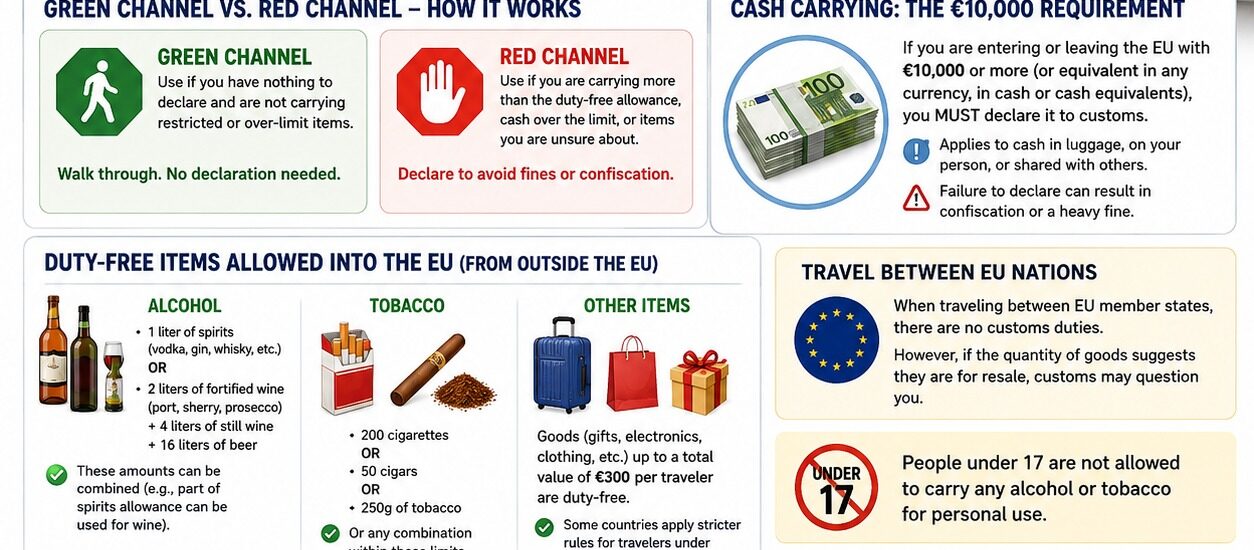
After landing on the European territories, passengers will have to make their way to one of the two channels at customs control:
Green channel: applicable if you have no duty-free limitations and do not carry restricted items. The green channel represents a chance to miss no relevant declarations.
Red channel: you have to go to the red channel if you are carrying a higher amount of alcohol, tobacco, and cash or if you are unsure about bringing something into the country.
Duty-Free Items Allowed into EU (From Outside EU)
If you enter the EU from outside its territory, you can bring in the same amount of items according to personal duty-free allowance per person.
Alcohol
You can take in the following alcohol:
– 1 liter of liquor (vodka, gin, whisky, etc.), or
– 2 liters of punch wine (port, sherry, prosecco) + 4 liters of still wine + 16 liters of beer.
The above quantities may be adjusted in any combination, for example, half of your liquor allowance can be used for punch wine.
Tobacco
The limit allowed in the EU is 200 cigarettes or 50 cigars or 250 grams of tobacco (or other combinations). Some countries may impose more strict requirements on travelers arriving from neighboring land or by sea transport.
Other Items
Gifts and appliances, clothes and other items are exempted from customs duties with an overall value of €300 per traveler. However, some countries impose even stricter restrictions on travelers under 15 years of age.
It is worth mentioning that people under 17 are not allowed to carry any alcohol or tobacco for their personal needs.
Travel between EU Nations
It does not matter if you are flying to an EU member state — the exemption from customs duty applies to all occasions when you are travelling between EU countries. However, if the quantity you are carrying indicates that the goods are likely to be resold, customs officials may question the passenger.
Cash Carrying: The €10,000 Requirement
Anyone entering or exiting the EU with a cash amount of €10,000 or greater (or its equivalent in any currency, be it whether cash alone or a combination of cash with cash equivalents, such as traveller’s cheques), has to notify customs officials about it regardless of whether the money is illegal or suspicious. Failure to report an amount above this threshold can eventually result in its confiscation or a significant fine, regardless of where the money comes from. This regulation applies to every situation, be it when cash is hidden in the luggage, on the body or shared with fellow travellers.
The Rule for 100ml Liquids (Carry-On Baggage)
The most frequent cause of confusion for travelers is the rule concerning liquids. All liquids, gel, and aerosols in carry-on baggage must be contained in a container of up to 100ml capacity. Furthermore, it is necessary to have all liquids in one clear resealable bag with a volume of not more than one liter. The following belong to this category:
– Water, beverages, and personal hygiene items
– Perfumes and cosmetics
– Contact lens solutions
– Dips, sauces, marmalades
In most cases, liquids obtained from duty-free shops after passing through security are exempt from having to comply with the limit as long as they are in tamper-proof bags with the receipts visible. But make sure that the exception holds true even if you change planes on your journey.
Describing items that have limitations or are totally prohibited from entering Europe, we may mention:
– Meat products, dairy products, and various products of animal origin imported from outside of the EU—there are often restrictions on such items regardless of how much of a product you have.
– Fresh fruits and vegetables, plants, and seeds—most of which are coming with restrictions imposed in order to